
Nutrition
The process by which living organisms obtain the inorganic and organic nutrients they need.
Purposes of Nutrition:
- Providing the necessary substances to meet the energy needs of living organisms.
- Supplying materials to be incorporated into the cell structure.
- Acquiring essential substances for regulating vital processes within the cell.
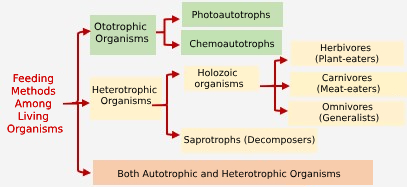
Main Modes of Nutrition in Living Organisms:
a. Autotrophic Organisms (Producers):
These are organisms that produce their own food.
Based on the energy source used for food production, autotrophs are classified into two types:
- Photoautotrophic Organisms:
These organisms use sunlight as an energy source to produce their food through photosynthesis. Examples include plants, certain protists (such as Euglena), some bacteria, and algae. They use CO₂ as a carbon source and H₂O, H₂S, or H₂ as a hydrogen source. - Chemoautotrophic Organisms:
These organisms obtain energy through the oxidation of certain inorganic substances and use this chemical energy to synthesize their food. Some bacteria and archaea serve as examples. They use CO₂ as a carbon source and H₂O as a hydrogen source.
An organism that performs chemosynthesis is necessarily prokaryotic.
b. Heterotrophic Organisms (Consumers):
These are organisms that obtain their required nutrients from external sources. Examples include humans, animals, fungi, certain protists, and some bacteria.
Heterotrophic organisms can obtain nutrition in three ways:
- Holozoic Nutrition: The process of ingesting solid food particles for nutrition. It is observed only in animals.
- Based on their diet, holozoic organisms are classified into:
- Herbivores (plant-eaters)
- Carnivores (meat-eaters)
- Omnivores (both plant- and meat-eaters)
- Based on their diet, holozoic organisms are classified into:
- Saprotrophs (Decomposers): These organisms secrete digestive enzymes onto dead plant and animal remains, as well as other organic waste, breaking them down and absorbing the necessary nutrients. This process not only fulfills their own nutritional and energy needs but also converts organic waste into inorganic substances that autotrophs can utilize.
- Yeasts, molds, and certain bacteria are among the most important decomposers.
- A decomposer organism can have either a prokaryotic or eukaryotic cell structure.
- Decomposers are present at all levels of both aquatic and terrestrial food chains.
Bacteria cannot perform exocytosis because they lack vacuoles. Instead, saprotrophic bacteria transport the enzymes (proteins) they secrete outside the cell using carrier proteins called translocases.
Ecological Importance of Saprotrophic Organisms:
- They help clean the environment (acting as nature’s recyclers).
- They enrich the soil with inorganic substances.
- They ensure the recycling of essential elements such as carbon and nitrogen.
- They facilitate biogeochemical cycles.
- They contribute to maintaining ecological balance.
The role of decomposers in the nitrogen cycle is to produce ammonia from amino acids.
If the number of decomposer organisms in an ecosystem decreases:
- Environmental pollution increases.
- Biogeochemical cycles, especially the nitrogen cycle, slow down.
- The accumulation of organic matter increases.
- The availability of inorganic substances decreases.
- If saprotrophic organisms are removed from an ecosystem, the ecosystem cannot sustain itself.
Chemoheterotrophic Organisms:
Chemoheterotrophic organisms obtain both their energy and carbon from organic compounds produced by other living beings. Unlike autotrophs, they cannot synthesize their own food and must consume organic matter to sustain their metabolic processes.
Examples of Chemoheterotrophs:
- Animals (including humans)
- Fungi (such as mushrooms and molds)
- Most protists (e.g., amoebas and paramecia)
- Many bacteria and archaea (such as pathogenic bacteria and decomposers)
These organisms play a crucial role in ecosystems by consuming organic matter, contributing to energy transfer through food chains, and, in some cases, facilitating decomposition and nutrient recycling.
Photoheterotrophic Organisms:
Photoheterotrophic organisms use light energy as their source of energy, but obtain their carbon from organic compounds produced by other organisms. These organisms are distinct from photoautotrophs because they cannot fix carbon dioxide, relying instead on organic carbon sources.
Examples of Photoheterotrophs:
- Certain aquatic and halophilic (salt-loving) prokaryotes, such as some types of bacteria.
Photoheterotrophs are primarily found in environments where light is available, but they also need external organic carbon to meet their nutritional requirements. They contribute to the flow of energy in ecosystems, particularly in specialized habitats like saltwater environments.
| Nutrition Type | Energy Source | Carbon Source | Example Organisms |
|---|---|---|---|
| Photoautotrophs | Light | CO₂ | Plants, algae, Euglena, cyanobacteria |
| Chemoautotrophs | Inorganic compounds (e.g., H₂S, NH₃) | CO₂ | Certain bacteria and archaea |
| Photoheterotrophs | Light | Organic compounds | Purple non-sulfur bacteria (certain prokaryotes) |
| Chemoheterotrophs | Organic compounds | Organic compounds | Animals, fungi, many bacteria, protozoa |
c. Both Autotrophic and Heterotrophic (Mixotrophic Nutrition)
- This is a type of nutrition carried out by organisms that function as both producers and consumers.
- The prominent examples of organisms that exhibit this type of nutrition are carnivorous plants and Euglenas.
- Carnivorous Plants: These plants grow in nitrogen-deficient soils and obtain the nitrogen they cannot acquire from the soil by digesting the proteins of captured insects.
- These plants are chlorophyll-containing, enabling them to synthesize carbohydrates and fatty acids and glycerol through photosynthesis. Examples of such plants include Sarracenia (pitcher plant) and Dionaea muscipula (Venus flytrap).
Carnivorous Plants: In terms of meeting their nitrogen needs, they are heterotrophic, but since they possess chloroplasts, they can also produce their own food through photosynthesis, making them autotrophic as well.
Euglena: This organism contains chloroplasts and synthesizes its own food in the presence of light, making it autotrophic. However, in the absence of light, it can take in ready-made food from the external environment, thus exhibiting heterotrophic behavior.
“Substances like water and minerals are taken up by all living organisms from their environment in a ready-made form.”