
Common Characteristics of Living Organisms: Cellular Structure
1. Cellular Structure:
All living organisms are composed of one or more cells, which are the smallest structural and functional units of life.
- The cell is the fundamental unit of life. It is the smallest functional structure that carries out the vital activities of an organism.
- Some organisms consist of only a single cell. These organisms are called unicellular organisms.
Examples: Amoeba, Paramecium, bacteria (including cyanobacteria). - Some organisms are composed of many cells, which come together in an organized manner. These are called multicellular organisms.
Examples: All plants and animals, most fungi, and some protists.
The statement “All living things are made up of cells“ (plural) can be misleading.. Instead, some organisms consist of a single cell, while others are made up of many cells.
- Based on their structure, cells are classified into two types.
Prokaryotic Cells:
These are simple cells that lack a membrane-bound nucleus and membrane-bound structures. The region where DNA is located is called the “nucleoid.” They contain ribosomes, which allow them to synthesize their own proteins. However, they do not have membrane-bound organelles.
- Only bacteria, cyanobacteria, and archaea have a prokaryotic cell structure.
Eukaryotic Cells:
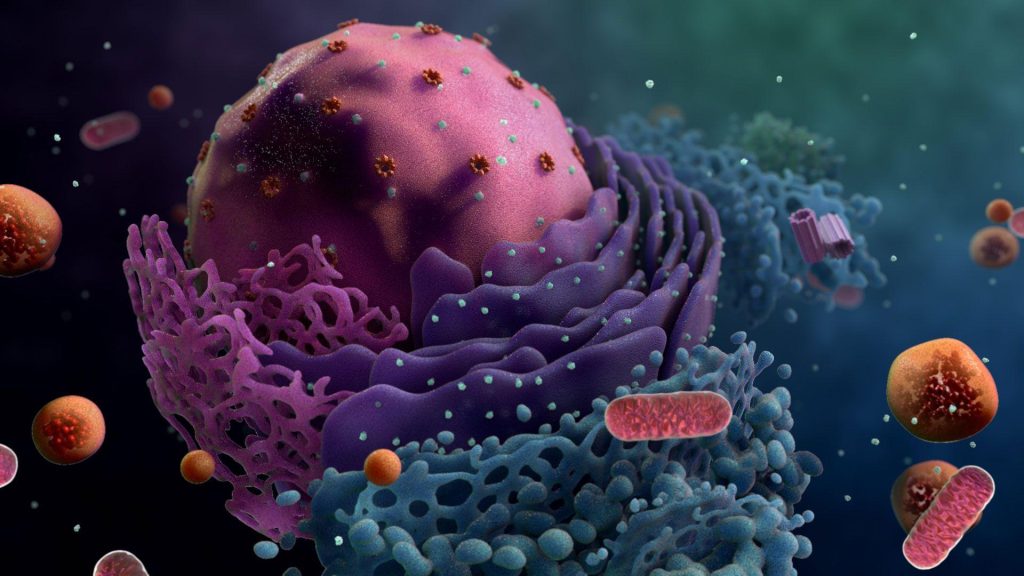
These are complex cells that contain a membrane-bound nucleus and membrane-bound organelles. Organisms such as protists, fungi, plants, and animals have a eukaryotic cell structure.
Common Features of All Cells (Both Prokaryotic and Eukaryotic):
- Cell Membrane (Plasma Membrane)
- Cytoplasm
- Genetic Material (DNA and RNA)
- Ribosomes (Protein synthesis machinery)
DNA is present in all living species and contains the same nucleotides.
| PROKARYOTIC CELL | EUKARYOTIC CELL |
|---|---|
| Appeared before eukaryotes (Primitive). | Appeared after prokaryotes (Complex). |
| Smaller and simpler structure. | Larger and more complex structure. |
| No membrane-bound nucleus or organelles. | Membrane-bound nucleus and organelles present. |
| No nucleolus. | Nucleolus present. |
| Single circular chromosome in the nucleoid. | One or more linear chromosomes in the nucleus. |
| Smaller ribosomes (70S). | Larger ribosomes (80S). |
| No histone proteins (except Archaea). | Histone proteins always present. |
| DNA replication begins at a single origin. | DNA replication begins at multiple origins. |
| Reproduce by binary fission (No mitosis). | Reproduce by mitosis and meiosis. |
| mRNA does not undergo post-transcriptional modifications. | mRNA undergoes extensive processing (e.g., splicing). |
| Protein synthesis starts with f-methionine. | Protein synthesis starts with methionine. |
| Cell wall is usually present (Peptidoglycan). | Cell wall present in plants and fungi (Cellulose/Chitin). |